

On the afternoon of October 4, the Ho Chi Minh City Department of Education and Training (HCMC DOET) signed an agreement with the Stanford Graduate School of Education (USA) and EMG Education to introduce the STEM Education Model through the Stanford Mobile Inquiry-based Learning Environment (SMILE).
Recently, UNESCO has recognized the SMILE model as an advanced and groundbreaking educational tool for the future, expected to have a positive global impact.
Technology Advances—The Fast Will Win
“The world is changing rapidly. Big no longer beats small; fast beats slow.”
Professor Paul Kim, Chief Technology Officer and Assistant Dean of the Stanford Graduate School of Education, quoted Rupert Murdoch at the seminar “STEM Education Orientation and Insights from Stanford University” held in Ho Chi Minh City on the morning of October 4.
Professor Paul Kim cited a report showing that a person’s productivity in 2012 (with extensive use of technology) was five times higher than in 2009, and by 2017, it could be 15 times higher.
This demonstrates that technology has fundamentally changed our lives, habits, and the way we work — from everyday activities like cooking and laundry to complex procedures such as surgery. Computers now perform many human tasks and can even engage in creative work such as composing music or painting—simply through a few keywords or clicks.
Today, with technological support, students no longer need to spend large sums of money to travel abroad; they can easily attend online courses from prestigious universities taught by Nobel laureates.
"The world is changing at a tremendous pace. Research shows that 65% of primary school students today will grow up to work in jobs that do not yet exist. This presents a major challenge for education—to nurture the people of the future: individuals who are creative, innovative, and inventive." - Professor Paul Kim
SMILE: Inspiring Creativity, Higher-Order Thinking, and Innovation
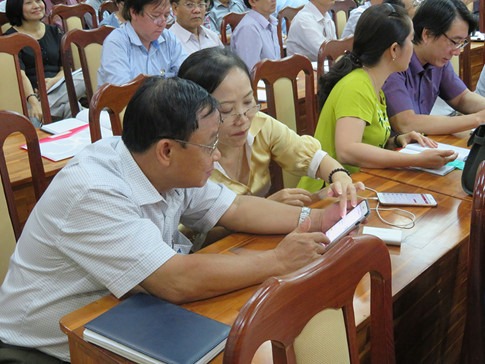
School Principals and Education Administrators in Ho Chi Minh City Trained to Use the SMILE Mobile Technology
“Technology changes, and so does life. The traditional learning method of memorizing and reciting is no longer suitable. We need to leverage technology in education—creating an open, flexible environment where students can practice, create, and invent right from school. That is precisely the goal of the Stanford Mobile Inquiry-based Learning Environment (SMILE) model,” emphasized Professor Paul Kim.
This advanced educational model is currently being implemented in over 30 countries, and its impact continues to expand globally.
Commenting on the model, Dr. Lê Hồng Sơn, Director of the Ho Chi Minh City Department of Education and Training, remarked:
“The SMILE technology platform from Stanford University will enable students to experience a new approach to learning. They will be able to apply the knowledge acquired in class to solve real-life problems and engage in scientific exploration. This helps them see the connection between theory and practice, between science and everyday life, and identify real-world issues that require further research and discovery. All of these experiences will foster a love of learning and provide opportunities for students to take their first steps into scientific research.”
As someone who has introduced the SMILE model to many countries around the world, Professor Paul Kim shared inspiring examples: in some countries, high school students have built computer-controlled parking systems; fifth graders have practiced heart surgery simulations using 3D printers; and remarkably, one elementary school student even used a 3D printer to create a prosthetic arm for a disabled child—bringing bright smiles to many other children who were born without limbs.
“We want to expand such models worldwide, and I truly believe that the students of the future will all become inventors, designers, and creators,” Professor Paul Kim affirmed.
The education sector in Ho Chi Minh City has always been a pioneer in innovation. The city has actively adopted advanced global teaching methods to nurture students who are not only strong in theoretical knowledge but also well-grounded in practical application—developing scientific thinking, adapting to social demands, mastering English and digital skills to meet regional and international standards, and becoming capable of working and conducting research in a globally integrated environment.
"The signing of the cooperation agreement to implement Stanford University’s STEM education model is one of the city’s concrete initiatives that align with its educational development orientation and respond to the practical needs of today’s world." - Dr. Lê Hồng Sơn Director, Ho Chi Minh City Department of Education and Training
Source: Thanh Niên Newspaper