

Ho Chi Minh City, October 4 – A signing ceremony was held between the Ho Chi Minh City Department of Education and Training (DOET), the Graduate School of Education at Stanford University (USA), and EMG Education to introduce the Stanford Mobile Inquiry-based Learning Environment (SMILE) – an innovative STEM education model developed by Stanford University.
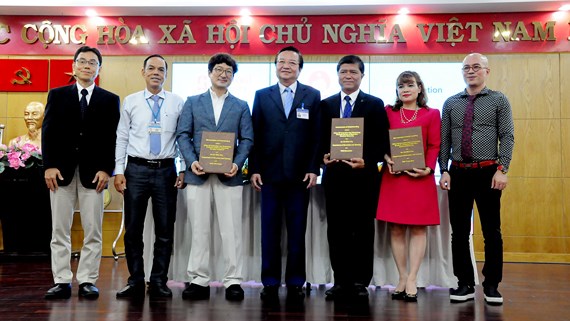
Representatives from the Ho Chi Minh City Department of Education and Training, Stanford University’s Graduate School of Education, and EMG Education signed a cooperation agreement
At the event, Professor Paul Kim, Chief Technology Officer of the Office of Innovation and Technology and Associate Dean of the Stanford Graduate School of Education, shared:
“Stanford’s cutting-edge educational technologies aim to foster intellectual growth, creativity, and scientific practice. They help learners develop problem-solving skills, nurture community engagement, and promote lifelong learning, entrepreneurship, and innovation. We hope to share the benefits of SMILE with Vietnamese youth and work with local partners to implement this new technology.”
The SMILE platform, or “mobile inquiry-based learning environment,” is the result of years of research by Stanford’s Graduate School of Education. The model can transform a traditional classroom into a high-tech learning space at an affordable cost. Once implemented, SMILE enables students to absorb knowledge and develop higher-order learning skills, while providing teachers and administrators with real-time analytical data.
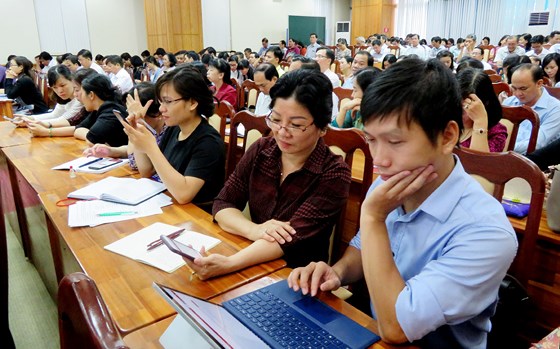
Principals from various schools in Ho Chi Minh City had the opportunity to try SMILE on computers and mobile devices
The main goal of SMILE is to develop students’ questioning skills and promote student-centered classroom activities. Its key feature allows students to create, share, and analyze questions enriched with images and multimedia. The system collects students’ answers and response times, storing this data for teachers to review. Educators can also use SMILE to create quizzes, facilitate group work, or even organize competitions—encouraging both collaboration and healthy competition in class.
SMILE’s core philosophy is to inspire learners to ask meaningful questions, using modern technology as the bridge. For example, mobile communication—texting, messaging, and sharing—has already become a natural habit among teachers and students. Thus, bringing these familiar tools like smartphones and laptops into the classroom is a logical and effective transition, requiring little adaptation.
Beyond convenience, SMILE offers clear cognitive and non-cognitive benefits. Writing concise and meaningful questions pushes students to think critically, creatively, and empathetically. The platform also empowers even the shyest learners to express their ideas confidently in a safe, digital environment.
Mr. Le Hong Son, Director of the Ho Chi Minh City Department of Education and Training, emphasized that the city has always been at the forefront of educational innovation and international integration.
“Implementing the SMILE platform as part of STEM education will give our students access to new learning methods and the chance to apply classroom knowledge to real-world problems. It bridges theory and practice, science and everyday life, helping students develop curiosity, creativity, and a love for learning,” he said.
As the local partner of Stanford’s Graduate School of Education, Ms. Nguyen Phuong Lan, CEO of EMG Education, expressed her optimism:
“This platform will give young learners in Vietnam access to Stanford’s advanced educational technologies and help realize the core goals of STEM education—developing high-level thinking and problem-solving skills.”
The collaboration marks an important milestone in efforts to modernize education through technology, promoting innovation and creativity across schools in Ho Chi Minh City and beyond.
Source Sài Gòn Giải Phóng