

Ho Chi Minh City has begun piloting the Integrated English Program at the preschool level from the 2026–2027 academic year, with high expectations for the program.
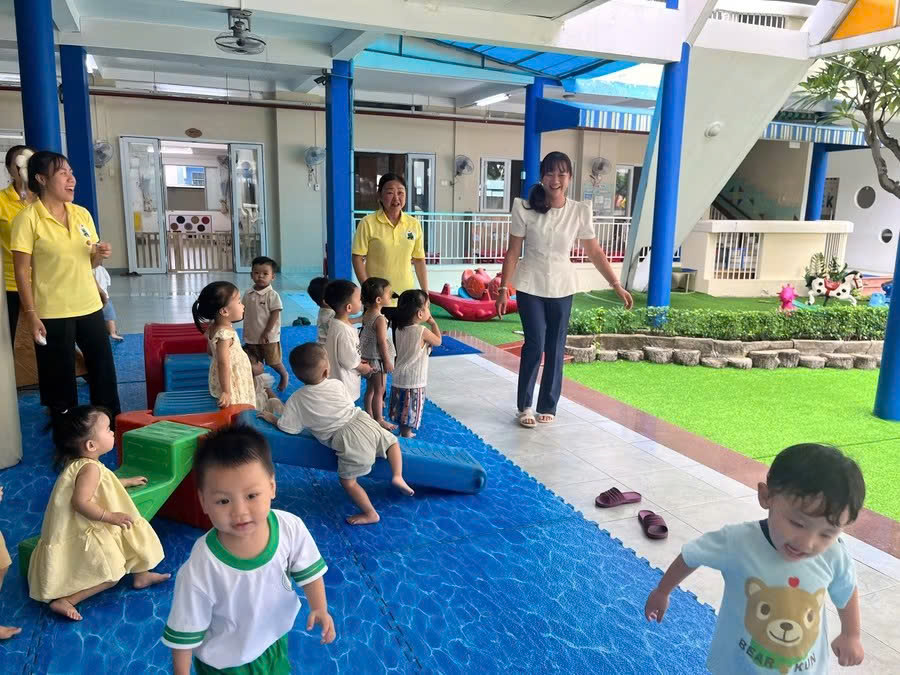
Ho Chi Minh City 19/5 Preschool, one of the schools piloting the Integrated English Program from the 2026–2027 academic year
Multiple Surveys Conducted to Give Parents Time to Consider
Immediately after Ho Chi Minh City approved the pilot implementation of the Integrated English Program at the preschool level, the selected schools began surveying and collecting feedback from parents.
At Ho Chi Minh City Preschool (Xuan Hoa Ward, Ho Chi Minh City), preparations had been underway for several months. The school had previously conducted a preliminary survey to understand parents’ needs, estimate the number of children likely to participate, and proactively plan for class organisation.
According to Ms. Ho Thu Thao, Principal of Ho Chi Minh City Preschool, after the Ho Chi Minh City People’s Committee approved the pilot implementation, the school continued to officially collect parents’ feedback and expected to organise one integrated class for each age group: 3–4, 4–5, and 5–6 years old.
Parents were provided with registration forms to indicate whether they wished their children to participate in the program. According to the school, parents who agreed to let their children participate showed considerable enthusiasm, with the initial number of registrations meeting the demand for class organisation. Each integrated class is expected to have 25–30 children.
“Parents at our school have an understanding of integrated education. Many of them have children studying integrated programs at higher education levels, so they are familiar with the program, and some parents are very interested in it,” Ms. Thao said.
At Ho Chi Minh City 19/5 Preschool (Tan Dinh Ward, Ho Chi Minh City), parents have also shown considerable interest. According to a preliminary survey, more than 110 children across the three age groups—3–4, 4–5, and 5–6 years old—have parents who agreed to let them participate in the program.
According to Ms. Mai Yen Hang, Principal of Ho Chi Minh City 19/5 Preschool, although the Integrated English Program has been implemented at the general education level in Ho Chi Minh City for many years, it remains a new model for preschool children and their parents. Therefore, the school has conducted multiple surveys to give parents time to learn about the program and carefully consider their decision. To date, the school has conducted three rounds of parent surveys.
The demand for children to be exposed to English from an early age is also one of the reasons behind parents’ interest in the program. According to the leadership of Ho Chi Minh City Preschool, the school has never previously organised English classes at the nursery level. However, when asked about the Integrated English Program, many parents expressed their desire for their children to become familiar with English from an early age.
Expectations for Children to Develop English Responses from an Early Age
Some parents believe that having an integrated English environment will provide more options, particularly as bilingual schools (private schools) have already been providing children with early exposure to English.
However, the schools’ goal is not simply to help children remember more English vocabulary or sentences, but more importantly, to create an environment where they feel confident using the language in familiar situations.
“We hope that once the Integrated English Program is implemented at the school, children participating in the program will be able to communicate in English within the preschool environment. We hope they will become more confident, be able to respond when spoken to in English, react more quickly to English, and greet others in English in the classroom,” Ms. Thao shared.
This is also the spirit set out in the pilot plan of the Ho Chi Minh City Department of Education and Training: to establish an initial foundation for English communication competence among preschool children, contributing to the goal of making English a second language in schools.
According to the plan of the Ho Chi Minh City Department of Education and Training, the program will be piloted for three years, from the 2026–2027 academic year through the 2026–2029 period, for preschool children aged 3 to 5 at eligible public preschool education institutions.
One of the key requirements is the voluntary participation and consent of children’s parents. The program must also ensure openness and transparency, operate on a non-profit basis, not use the state budget, and safeguard the quality of education and children’s rights.
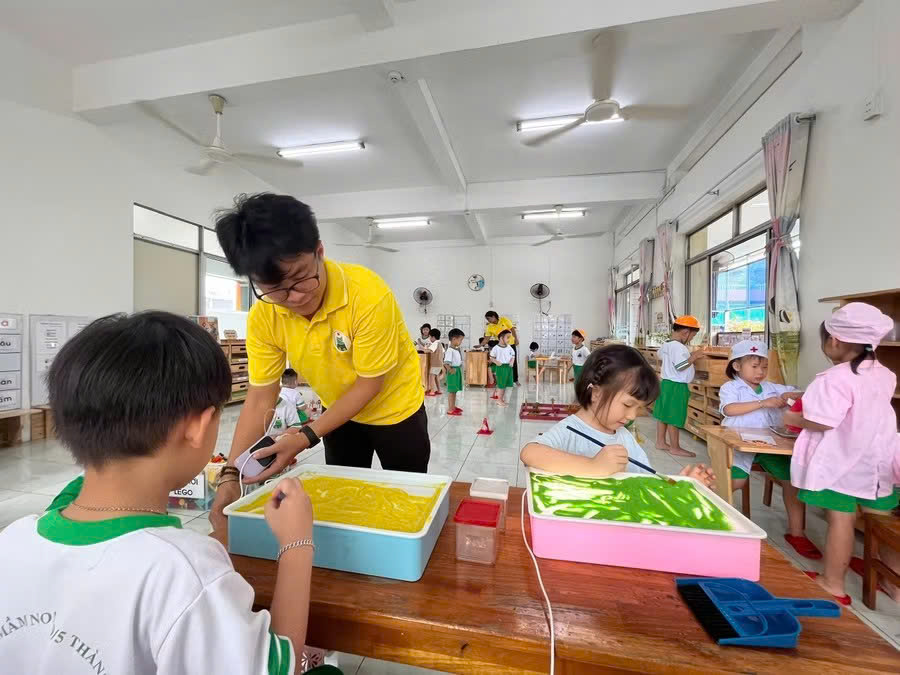
Inside a classroom at Ho Chi Minh City 19/5 Preschool
Schools must publicly disclose the program, materials, learning resources, duration, organisational methods, fees, and related expenses so that parents have sufficient information before making a decision. In particular, the pilot program must not affect the implementation of the current Preschool Education Program. Children who do not participate in the program must still be guaranteed their full rights to learning, care, and education.
The teaching content follows the English Familiarisation Program for Preschool Children issued under Circular No. 50/2020/TT-BGDĐT. Instead of treating English as a separate learning activity, the program integrates English into activities that familiarise children with Mathematics, language, and the exploration of the world around them. Children aged 3–4 and 4–5 are expected to participate in four activities per week, while children aged 5–6 are expected to participate in six activities per week. The duration of activities is designed according to the psychological and developmental characteristics of each age group. Materials and learning resources used in the program must ensure scientific and systematic content, age-appropriateness, and alignment with modern educational approaches such as learning through play, project-based learning, and child-centred education.
After three years, Ho Chi Minh City will review and evaluate the program, learning resources, organisational model, and financial mechanism as a basis for proposing an implementation plan for the following period.
Foreign teachers and academic support staff involved in teaching and providing support will be arranged by the program provider and must meet the standards prescribed by regulations. Regarding funding, the collection and organisation of pilot service fees shall comply with Official Letter No. 10004/SGDĐT-KHTC dated September 23, 2026, issued by the Ho Chi Minh City Department of Education and Training on the implementation and guidance for organising service fees other than tuition fees for the 2026–2027 academic year at public education and training institutions. |
According to Giáo dục và Thời đại